
what is forensic anthropology?

Symphysis pubis (Richard Jones 2015)
Forensic anthropology is a sub-specialty of physical anthropology, and is concerned with the application of expert knowledge about skeletal anatomy to issues of forensic importance, including the identification of the deceased (where the remains are completely, or partially, skeletonised), and the identification and interpretation of bone trauma.
Principles derived from studying skeletal anatomy of archeological specimens and 'collections' of skeletons are applied to the examination of bones found in a forensic context (e.g. clandestine burial), with a view to providing information relevant to the identification of the deceased, including estimations of;
- ancestry,
- age at death,
- sex, and
- stature.
Forensic anthropologists can play an integral role in death investigations, and can assist in the identification of remains at the scene, recovery of those remains (utilising archeological principles), and examination in the mortuary, alongside the forensic pathologist.

Source: Wikipedia
what is forensic anthropology? (FutureLearn - Dundee University)
forensic anthropology (and entomology) on Pinterest
Follow Richard's board Forensic anthropology and entomology on Pinterest.
human identification (the Wellcome Collection)
identifying burial sites - forensic science field techniques video
how are human remains exposed and uncovered by forensic anthropologists & archeologists? (FutureLearn - Dundee University)
human bone manual
revise your pelvic bone anatomy
the Body Farm and art
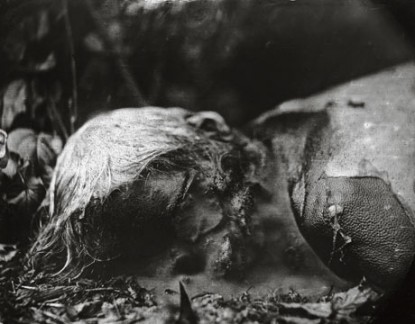
Untitled WR Pa 53 2001
Source: Sally Mann at the Guardian
Photographer Sally Mann created a series of photographs called 'What Remains', taken at the University of Tennessee's Knoxville Anthropological Research Facility (aka 'the Body Farm). These photographs have been described as some of her most challenging pieces ('I like pushing buttons').
Death makes us sad, but it can also make us feel more alive... I couldn't wait to get there. The smell didn't bother me. And you could see the colours - they're really beautiful. As Wallace Stevens says, death is the mother of beauty.
Sally Mann in The Guardian (Morrison B. The naked and the Dead. The Guardian 29/5/2010)

The entrance to the 'Body Farm'
Source: Jefferson Bass

Skeletalisation at the Body Farm
Source: Jefferson Bass

Skeletalisation with exposure of a prosthetic hip at the Bosy Farm
Source: Jefferson Bass
post mortem changes on Pinterest
Follow Richard's board Forensic pathology - changes after death on Pinterest.
Superimposition and human identification: The Ruxton Case 1935
———
 |
 |
 |
 |
 |
 |
 |
 |
 |
 |
———
Interactive superimposition: the Ruxton Case

skull from a 'torso murders' victim, Cleveland, Ohio, USA (1935-1938)
source: the Cleveland Memory Project, Cleveland State University Special Collections
forensic facial reconstruction

Mikhail Gerasimov - source: Wikipedia
When other identification means have been exhausted, forensic anthropology meets forensic art to provide a skull with a recognisable face.
Forensic facial reconstruction has been utilised for many decades, with some notable success. The pioneer of this forensic technique was Mikhail Gerasimov (1907-1970), who provided the role model for Professor Andreev in Martin Cruz Smith's novel, Gorky Park.
frontal sinus pattern - identification


Some researchers have considered the frontal sinus to be characteristic, and capable of providing evidence of 'uniqueness'/ individualisation. The top radiograph shows the frontal sinus in relation to the remainder of the facial bones/ skull, whilst the lower image is a close-up of the frontal sinus.
Source: wikiradiology (Wetpaint)
See the frontal sinus pattern visible in a skull x-ray reportedly of Hitler at Wired Science.
radiographic bone age

Age can be assessed by reference to bone age - this is a radiograph of the left hand of a male with a bone age of 24 months.
For more examples of bone age, and a full size version of this radiograph, go to wikiradiography (made available by Wetpaint).
written in bone - interactive comic story

The secret in the cellar - a Written in Bone forensic anthropology mystery via the Smithsonian National Museum of Natural History
An exploration of what happens when you decompose: 'After life' by the artists French & Mottershead
Artists Rebecca French and Andrew Mottershead talk in the radio programme below about the inspiration behind their immersive digital artworks that explore decomposition and death.
Afterlife describes in visceral yet poetic detail the course of a human body’s decay in four different settings: a woodland visitor rots in the elements, eventually turning to stone; a museum viewer dries out and becomes a preserved sculpture; a body in water transported by currents and tides is transformed to sand, and a person at home remains undiscovered.
Clear Spot - 18th December 2015 (French & Mottershead) by Resonance Fm on Mixcloud
new avenues for forensic anthropology? 'odor mortis' and the Casey Anthony trial
There is something wrong. I found my daughter's car today and it smells like there's been a dead body in the damn car.
Cindy Anthony, July 15th 2008
On July 15th 2008, Caylee Anthony, a two-year old girl, was reported missing by her maternal grandmother, who told emergency services that her daughter's car smelled like there had been a dead body in it. That smell, it was subsequently discovered, was emanating from the boot (trunk), where there was some rubbish (garbage).
Caylee's skeletalised remains were discovered on December 19th 2008 in a wooded area close to the family home.
At the trial of Caylee's mother, Casey Anthony, it was argued that the smell of decomposition in the boot of the car had come from Caylee's body being transported in it, and the prosecution called Dr Arpad Vass - a forensic scientist with a special interest in the process of decomposition - to give evidence about his analysis of the 'odour' of decomposition present in that car. This evidence was controversial, and disputed by the defence.
Casey Anthony was found 'not guilty' of Caylee's murder.
Watch Dr Vass give evidence and read his paper on 'Odor Mortis'. The questions that remain are: should his evidence have been permitted at trial? Is this an avenue of exploration that will be verifiable in the future? Is it reliable? Was this evidence 'flawed', as some critics maintain?
For more information about this case, follow the links curated at https://delicious.com/rmjones/search/casey_anthony
Introduction to forensic anthropology (4th Edition)
the juvenile skeleton
forensic anthropology: graphic novel-style

crosswords and other puzzles

- crosswords, word search and matching puzzles for all school-ages (eskeletons.org)


Forensic anthropology - 2000 to 2010. Black S, Ferguson E (ed). CRC Press (Taylor and Francis) 2011
Buy it here ...
Menu
forensic anthropology links

- eskeletons
- virtual skeleton (QTRV movies of many bones)
- gunshot wounds in bone (QTVR movies)
- forensic anthropology (Wikipedia)
- forensic anthropology at osteointeractive
- British Association for Human Identification (https://www.bahid.org/)
- American Board of Forensic Anthropology
- decomposition (australian museum online)
- physical anthropology lecture resources (University of Hawaii-Manoa)
- forensic anthropology measuring devices (osteointeractive)
- gunshot wounds in skulls (at osteointeractive) and gunshot wounds summary
- forensic anthropology courses
- forensic anthropology centre (University of Tennessee)
- online human skeleton booklet (also available in a flash paper format)
- comparative anatomy booklet (flash paper)
- what happens after death? (Australian Museum)
- forensic archeology
- forensic anthropology/ osteology videos (at Vodpod)
- facial reconstruction stages (QTVR movies)
Apps for forensic anthropology/ pathology


- Shadow Forensic Anthropology Lite - stature estimation utilising various long bone lengths (additional functions to follow)

Forensic Taphonomy: the postmortem fate of human remains. Haglund WD and Sorg MH (Ed)
Buy this book here ...
See inside this book at Google Books ...
